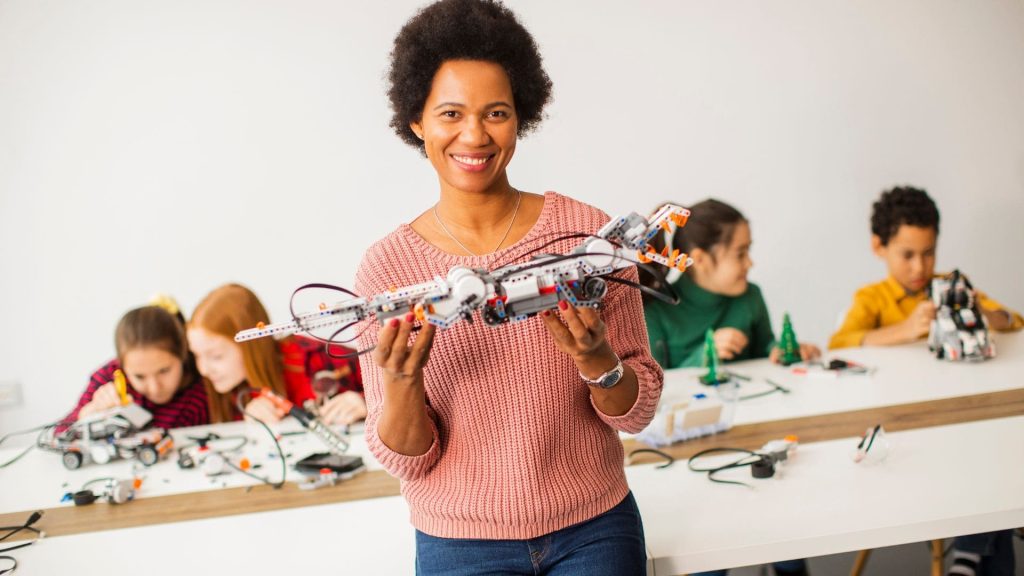
As we move deeper into 2026, the Fourth Industrial Revolution (4IR) is no longer a concept for the future—it is the operational reality of the South African Department of Basic Education (DBE). With the full-scale implementation of the Coding and Robotics CAPS curriculum for Grades R–9 now in effect, educators are standing at a professional crossroads.
The Science Behind the Machine: What Robotics Really Involves
Robotics is the quintessential multidisciplinary science. It isn’t just about “building a bot”; it is the practical application of three complex scientific pillars:
- Mechanical Kinematics & Dynamics: This is the study of motion and the forces that create it. In the classroom, you teach learners how to manipulate torque and gear ratios to overcome friction—turning abstract Physics into a tangible success.
- Electronic Sensing & Actuation: Robots interact with their environment through a “Sense-Think-Act” loop. Using sensors (like ultrasonic sensors measuring distance via the speed of sound) and actuators (motors), students learn the fundamentals of electrical engineering and circuitry.
- Computational Intelligence: This is the logic layer. It involves teaching algorithmic thinking—breaking down global problems into local, solvable steps using sequences, loops, and conditional logic.
The South African Context: Efforts and Urgency
The South African government has made a monumental commitment to this transition. The DBE has already piloted the curriculum in over 1,770 schools nationwide . However, a significant “readiness gap” persists. Research from North West University highlights a shortage of approximately 31,000 teachers in the system, many of whom lack the technical confidence to deliver this new curriculum.
Global Stats to Consider:
-
According to the World Economic Forum’s Future of Jobs Report 2025, over 60% of employers expect digital access and automation to transform their business by 2030 .
-
The World Bank estimates that jobs requiring digital skills will reach 230 million across Sub-Saharan Africa, potentially adding $130 billion in revenue to the continent’s economy.
For South African educators, the urgency is clear: we must produce a workforce that can fill these roles, or risk leaving our youth behind in a global economy.
Beyond the Bot: What Kids Actually Learn
While the final product might be a robot that navigates a maze, the true value lies in the invisible skills forged during the process. When students engage with robotics, they are developing a robust toolkit for the 21st century:
- Resilience and “Debugging” Mentality: In robotics, failure is not a grade; it is a data point. Students learn that a robot not doing what it’s told isn’t a disaster—it’s just a “bug” to be fixed. This builds incredible emotional resilience.
- Hard STEM Integration: Studies show that students engaging in robotics improve their math understanding by 25% and science understanding by up to 47%. They apply geometry to calculate wheel rotations and physics to understand weight distribution.
- Soft Skills and Collaboration: Robotics requires communication, delegating tasks (builder, coder, project manager), and conflict resolution when designs clash.
- Design Thinking: Students learn to empathize with a problem, ideate solutions, prototype a physical model, and test it iteratively.
From Blocks to Breadboards: Navigating the Options
The robotics landscape is vast, and choosing the right tools is crucial for age-appropriate learning. Fortunately, the market offers a fantastic scaffolding of options:
- Screen-Free Robotics (Grades R–3): Tools like Bee-Bots or Matatalab require no screens or reading skills, teaching foundational sequencing and spatial awareness.
- Block-Based & Snap-Together Kits (Grades 4–7): Platforms like Scratch and TinkerCAD allow students to build complex structures and code them using drag-and-drop interfaces.
- Text-Based & Open Source Hardware (Grades 8–9+): Students transition to text-based languages like Python or C++, using microcontrollers like Arduino and Raspberry Pi alongside raw electronic components.
What an Ideal Curriculum Should Focus On
An ideal, high-impact curriculum should focus on Purpose Over Play:
- Locally Relevant: Challenges should mirror real-world South African problems (e.g., an automated irrigation system for local agriculture).
- Process-Oriented: The focus must remain on the Engineering Design Process rather than the final product. Assessment should reward creative problem-solving and logical thinking.
- Progressive: It must seamlessly transition learners from “unplugged” paper-based logic in the foundation phase to complex, sensor-driven automation in the senior phase
Advancing Your Career: From Teacher to Edupreneur
Mastering robotics is the single most effective way to future-proof your career. The DBE has already piloted the curriculum in over 1,770 schools nationwide. Yet, research from North West University highlights a shortage of approximately 31,000 teachers equipped to deliver it.
For South African educators, stepping into this gap offers unprecedented benefits:
- Rapid Promotion & Employability: High demand for HODs and Subject Advisors specialized in Coding and Robotics.
- SACE Recognition: Completing accredited training earns you vital CPTD points, marking you as a “fit-to-practice” professional.
- The Entrepreneurial Leap (Open Your Own Club!): Learning robotics makes you an entrepreneur. You can open your own after-school robotics club, host weekend tech camps, or run holiday workshops, creating a highly lucrative secondary income stream while bringing vital STEM education to your immediate community.
It’s Not Difficult—If You Have the Right Partner
The biggest barrier for many teachers is the fear that robotics is “too hard.” This is a myth. At XRobotics Club, we specialize in demystifying technology. We believe that if you can teach a child to read, you can teach a robot to move.
Our programs are designed specifically for educators with zero technical background. We provide:
-
Step-by-Step Scaffolding: We move from “unplugged” logic (no devices) to block-based coding, and eventually to physical assembly.
-
Practical Classroom Kits: Our hardware is intuitive, removing the frustration of traditional engineering.
-
Ongoing Mentorship: You aren’t just taking a course; you’re joining a community of innovators.
The Global Imperative
The global economy is moving fast. According to the World Economic Forum’s Future of Jobs Report, the vast majority of employers expect digital access and automation to transform their business by 2030. Additionally, the World Bank estimates that jobs requiring digital skills will reach 230 million across Sub-Saharan Africa, potentially adding $130 billion to the continent’s economy.
Don’t let your career—or our learners—get left behind. Embrace the future of the classroom today.